Equipment for Handling Live Doughs
Tearing the delicate gluten network during rapid transport often generates severe deformations and structural waste. Industry operators frequently assume the formulation fails, but the actual financial impact stems from mechanical stress. Implementing stress free handling systems, dynamic fermentation, and active cooling protocols will definitively solve this complex operational production problem.
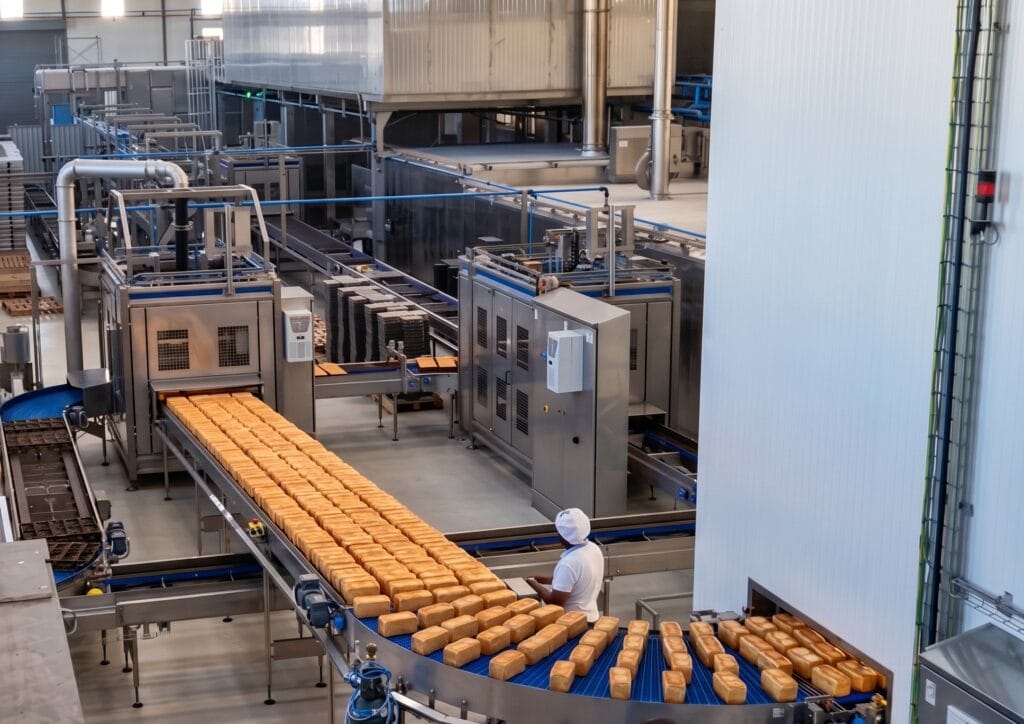
Processing hydrated doughs at industrial capacities requires rigorous physical and thermodynamic control. The dough is a viscoelastic and living material, highly sensitive to friction and temperature changes.
Mechanics of Stress Free Transport
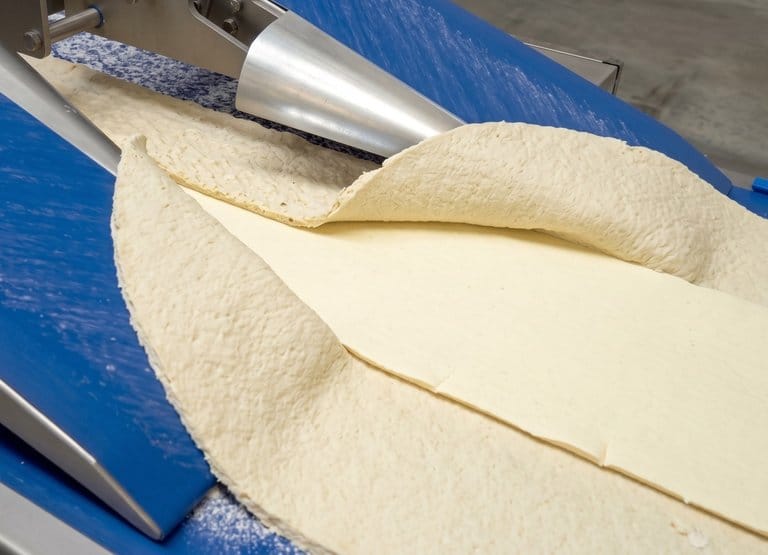
Transporting through linear handling equipment has the potential to subject the dough to shear forces. When a dough portion moves between belts with unequal speeds, surface friction could tear the internal cellular structure.
To prevent this degradation, modern lines utilize stress reduction technologies. These technical solutions include:
These design characteristics ensure that mechanical pressure does not degas the dough piece, thereby preserving an open and uniform crumb texture.
Thermodynamics of Dynamic Fermentation
Swing tray proofers keep the product in continuous motion during cycles of approximately 40 minutes.
Keeping the dough in motion helps prevent air stratification inside the chamber. This process often results in a homogeneous distribution of heat and humidity. The benefits of this thermodynamic stability include:
The Physics of Active Cooling and Stabilization
Once the bread exits the indirect fired oven, its core temperature is around 95°C. Extracting latent heat without collapsing the structure requires active cooling spirals for approximately 75 minutes or vacuum cooling systems.
Cooling fulfills primary chemical and structural functions. If the bread is packaged before reaching thermal equilibrium, the migration of water vapor towards the crust often results in condensation inside the bag. This scenario increases surface water activity and could cause accelerated mold growth.
Additionally, the cooling process stabilizes the bread through the following mechanisms:
😊 Thanks for reading!
Sources:
- Moline Machinery. “Dough Processing Equipment”. https://www.moline.com/dough-processing/dough-processing-equipment/
- Cauvain, S. P. (2015). Technology of Breadmaking (3rd ed.). Springer.
- Kozak, O., & Telychkun, V. (2024). Mathematical Model of Vacuum Cooling of Bread. National University of Food Technologies.
- Royal Kaak. “Tinbread line with maximum capacity of 8.500 breads per hour”. YouTube, https://www.youtube.com/watch?v=CoC9JRh7QO8
Enhance your technical knowledge with our detailed resources on What is Shrinkflation in Industrial Bakery?, Mastering High-Volume Tortilla Manufacturing, and Microencapsulated Essential Oils Extend Shelf Life Without Yeast Inhibition.