Moisture Migration in Industrial Pies
Moisture migration often softens pie bases, ruining their initial texture. This structural defect could lead to returns and reduce commercial viability. Implementing the hot water method or advanced lipid barriers might seal the porous matrix, effectively solving this complication.
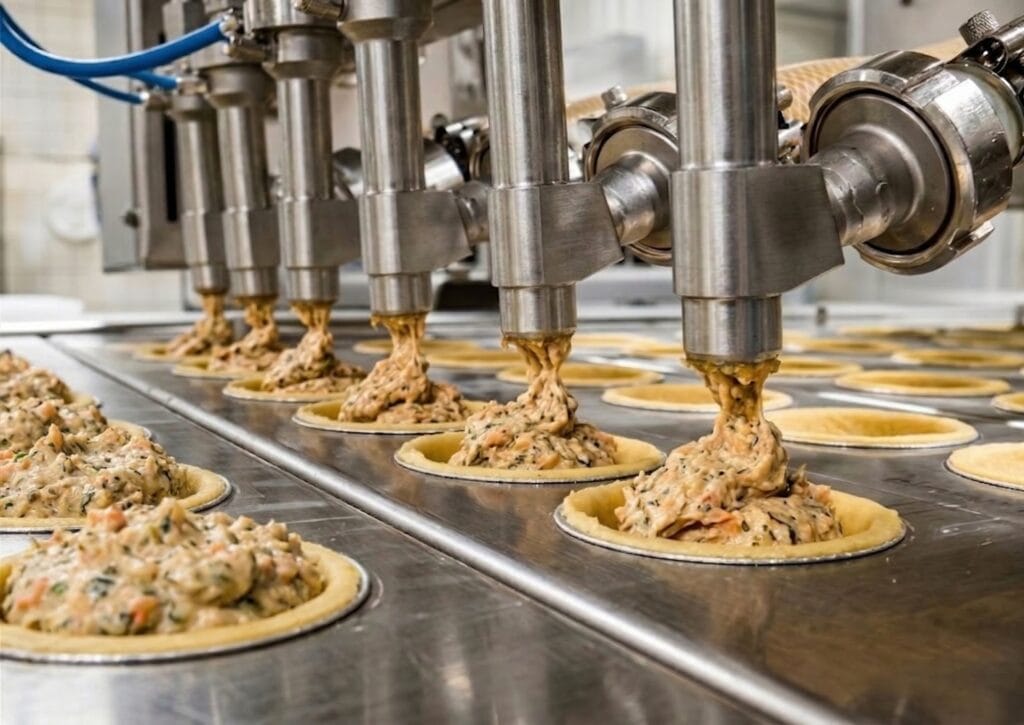
The production of pies on an industrial scale often presents itself as a complex area that might require perfectly balancing dough chemistry with the moisture dynamics of fillings. A structural defect that could be considered highly critical is water migration from the filling to the base; this phenomenon would tend to result in a soggy product that might lose quality during its commercial shelf life.
The Hot Water Method and Lipid Dispersion
To mitigate this problem, a physicochemical strategy that emerges as highly effective could be the Hot Water Method.
In the preparation of dough for savory pies, the incorporation of hot or boiling water during mixing might be the preferred technique. The thermodynamics of this process would indicate that high temperature can melt the solid fat present in the formulation. By transitioning to a liquid state, this fat would disperse much more efficiently, potentially penetrating and sealing the microscopic voids within the dough matrix.
This physical blocking of moisture migration would generate positive impacts on shelf life and texture:
- Internal barrier: Its creation would make it difficult for water from the filling to migrate through the porous structure of the baked base.
- Structural preservation: By keeping the water contained inside, the progressive softening of the pastry could be avoided.
- Sensory improvement: The use of hot water would potentially increase the crispness of the base throughout the entire storage period.
Rheological Limitations in Sweet Matrices
However, it would be imperative to consider that this thermodynamic solution presents restrictions depending on the product profile. If the hot water method were applied to sweet pies, the interaction would change drastically. High temperatures could cause sugars to dissolve quickly to form a syrup within the matrix.
This would alter the dough’s rheology, possibly producing a soft and highly sticky paste. Operationally, this modification would make the dough more difficult to process mechanically. In these cases, industrial plants might require specialized equipment, such as adapted extruders or robust spiral mixers, to prevent continuous blockages in high-speed molding lines.
Technological Alternatives
Given these rheological limitations, the current industry might be using the following technologies to prevent moisture migration without altering the original formulation of sweet doughs:
- Llipid coatings: Layers of high-melting-point microparticulated lipids, combined with low-melting-point triglycerides, could be applied, forming a continuous barrier that would block moisture.
- Hydrocolloid matrices: The use of polysaccharides, such as alginate, pectin, or cellulose derivatives integrated with fats, would help create flexible cross-linked structures that might not crack during commercial handling.
- Enzymatic modulators: Certain biological treatments could strengthen the base matrix before baking, considerably reducing cellular permeability.
These alternatives, combined or used as substitutes for hot water, might offer highly versatile solutions to prolong freshness and maintain the desired texture in multiple types of large-scale production.
😊 Thanks for reading!
Sources: https://patents.google.com/patent/US5130150A/en https://patents.google.com/patent/US7226630B2/en https://patents.google.com/patent/CA2575413C/en
If you found this article helpful, explore our related coverage on Ditching DATEM and Cutting Costs: The Enzyme You Might Be Missing, How De-Proteinized Wheat is Fixing the Gluten Free Crumble, and The High-Sugar Headache: Solving Osmotic Inhibition Without Adding Yeast.